

Putting climate ethics into action
On footprint fantasies & the myth of individual responsibility

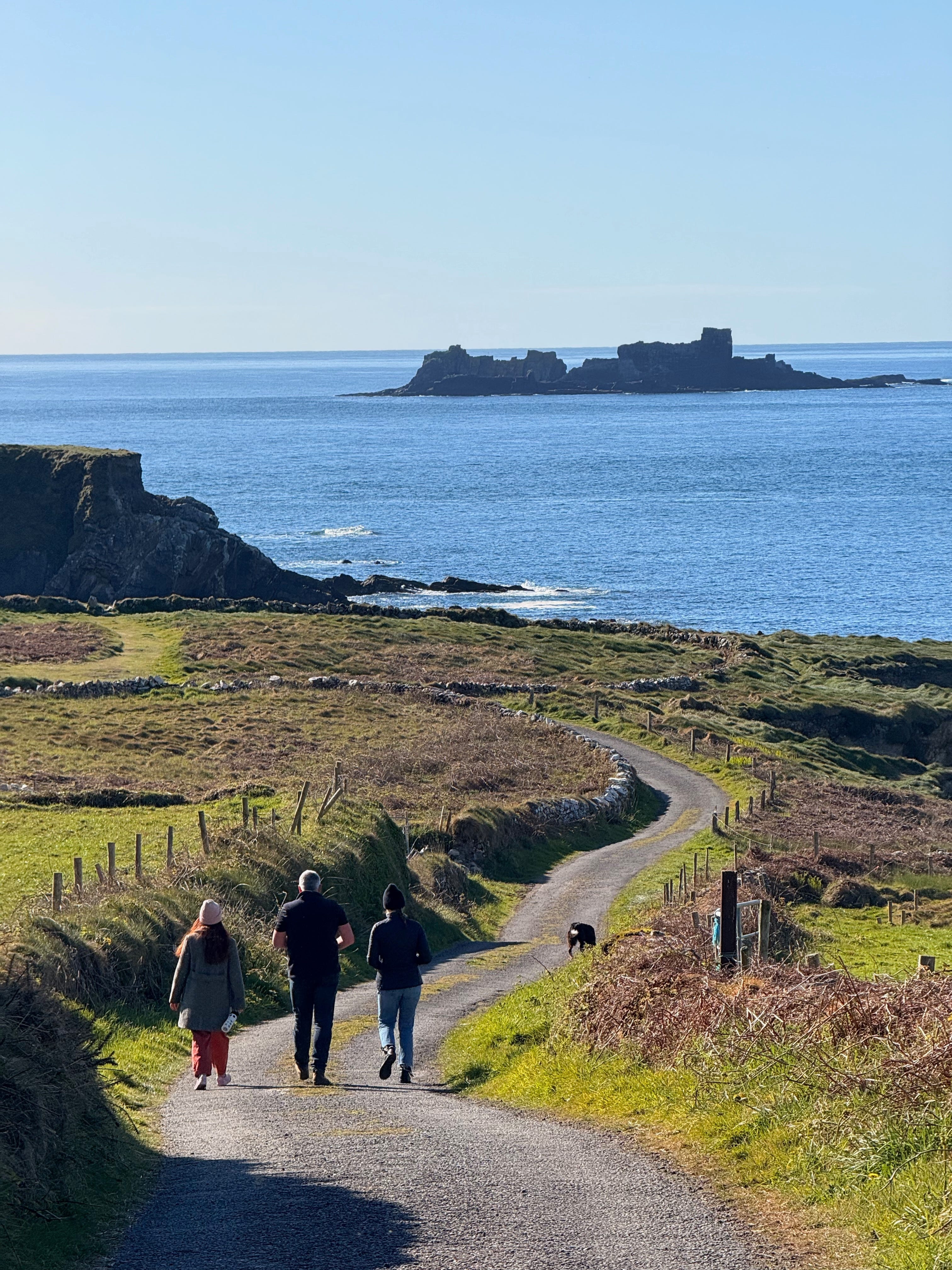
A couple of weeks ago, we landed in Dublin to begin our spring season, right in the midst of the farmer/haulier protest against the rising fuel prices. We passed areas on the motorway that were almost completely blocked by tractors and large trucks, but we also saw the corridors purposely kept open for emergency vehicles and others to pass through. Though much of the media would have you think that the protests were a right wing effort, the reality was they were working class people who felt strangled by the dramatic upswing in gas and oil prices due to America’s war on Iran. The protest was not the result of an organized campaign, but a more spontaneous reaction to the lack of government protection that other EU countries were affording their citizens–and one that ultimately brought the Irish government to the negotiating table in a matter of days.
It’s actions like these that give me hope, in large part because they are communal in nature. The people who pulled this off would not have been capable of achieving the same results if they had not worked with their neighbors and other businesses with shared interests. It’s also a reminder to me that our power to make change happen is always stronger when we work together–something that is so easy to forget, given how much our society emphasizes individual responsibility over everything else.
One area that is incredibly difficult to put into practice on a purely individual level is traveling sustainably in Ireland on a vacation. We often work with people who want to put their climate ethics into action and therefore want to rely solely on public transportation; at the moment we are planning two different trips like this. These clients also want to be able to spend time in more remote, rural accommodation which is off the beaten path. What I’ve come to believe is that their perception of the ease with which one can travel around the country in Ireland is informed by their trips to other European countries. It is for this reason that in our initial consultation, I always make a point of telling people that the Irish rail system was better a hundred years ago than it is today. The unfortunate reality is that absent a major public infrastructure upgrade, this kind of low-impact travel is just really hard to do in Ireland right now.
It’s fair to say that I think about climate impact often—and even more so since starting a travel company. And so when I saw that Grist Magazine’s recent column “Ask a Climate Therapist” focused on traveler’s guilt, I snapped to attention. The article posed the question, How do you balance a love for travel with guilt about its emissions?
I have to admit that I almost read it through my fingers. I was prepared to find one of two extremes: a watery, feel good response meant to completely absolve the questioner, or its opposite, in the form of recommendations so rigid that one might as well decide to never go anywhere again.
I often feel tension around the issues of sustainability when it comes to the work I do with Bog & Thunder. It’s funny–it’s not the most obvious contradictions (air miles) that bother me so much as it is the storytelling aspect of it all. Meaning, how to walk the line between shining a light on what’s happening in Ireland that is most positive and regenerative and hopeful, and exposing the blatant greenwashing for what it is (especially when I see it left, right, and center).
I have the benefit, I suppose, of having an educational background in environmental policy, sustainability, and environmental justice. In practice, this means that I know enough about environmental issues to know what I don’t know, and how to ask questions or find out the information I need when I come up short. I imagine myself having a few more tools in my toolbox than the average travel company owner as I approach my work because of my education (but I suppose we are all doing the best we can with what we have, right?).
And yet I bristle at the implication that it is the responsibility of the individual to account for the jet fuel consumed by billionaire owned airlines. It’s such a deeply American response, isn’t it, to believe that if I forgo air travel, I will push the needle forward in a meaningful way? No matter that institutional change isn’t happening at the political level in this regard, no matter that during covid, when the world all but stopped, empty airplanes crisscrossed the globe every single day out of fear that an airline grounding their fleet would cause them to lose their flight schedules.
Did you know that it was an advertising company hired by BP that invented the whole concept of “carbon footprints”? Here’s a little background about how this came to be (also from Grist):
…the conversation about our personal carbon emissions has been around for decades. Environmentalists have long obsessed over the emissions associated with their lifestyle decisions — whether to fly, own a car, and eat red meat. It’s a concept made popular by — get this — BP itself. More than 20 years ago, one of the company’s marketing campaigns helped cement the perception that the responsibility for reducing emissions lay with individuals, working the phrase “carbon footprint” onto our tongues. The underlying message: Let’s talk about how to solve your emissions problems.
You might think that a company evangelizing the carbon footprint would have its own house in order. But research shows that since the late 1980s, just 100 big companies — including BP — are responsible for about 70 percent of global emissions. BP is near the top of the list of the highest-emitting companies in the world, responsible for more than 34 billion metric tons of carbon emissions since 1965.
Even knowing this, in the earlier days of building my company, I spent a good amount of time searching the internet for the correct variables to add to an overly complex equation meant to determine an approximate carbon footprint of a potential guest on one of my tours. Most offset programs are at best misguided and at worst outright scams, and yet somehow I thought coming up with a nice round number might one day tip the scale in favor of being hired by an environmentally minded traveler one day.
I fully support decarbonization, but I also know that sitting here at my desk wrestling with complex equations meant to prove my commitment to sustainability when most of the inputs I use in Ireland are outside the realm of my control (lack of public transportation and inaccessibility of electrified alternatives, to name just a couple) is not going to save the earth.
I still ponder these questions pretty regularly, however–especially when I see a new article about so-called sustainable travel trends. Like this one from a few days ago. Rewilding landscapes? Okay, great. Extending into the off season? We all know this means more travelers for more of the year. Using AI to help eliminate food waste? I simply cannot.
So, what should I be doing? Sometimes, after I’ve put all of my little sustainability ducks in a row, it seems like it comes down to running a travel company…or not. Thankfully, I don’t think abandoning my business is the change I wish to see in the world.
For now, I’m using my company (and our conversations on Dyed Green!) to educate people about nature, food, culture, and place; to build community and connections; and to make meaning in an often harsh and lonely world. I know it’s not “enough,” but the reality is that we need much more than just everyone doing their part. We need major society-wide, political and infrastructural changes to be made. People want the choice to travel sustainably, but do not have the opportunity to make those choices unless and until things happen at the policy level. (And don’t even get me started on data centers!)